The RAG Mastery Series · For developers who build production AI
Build AI apps that answer from evidence.
— The Pramana Framework
Most AI tutorials stop at the API call. This series starts where tutorials end — at the moment your chatbot returns a confident, wrong answer, and you have no idea why. Four books. One project. The complete path from first embeddings to production.
Book 1 always freeNo account neededPython · real project · production stack
The Problem Nobody Names
Your AI assistant returns a confident, fluent answer. The answer is invented.
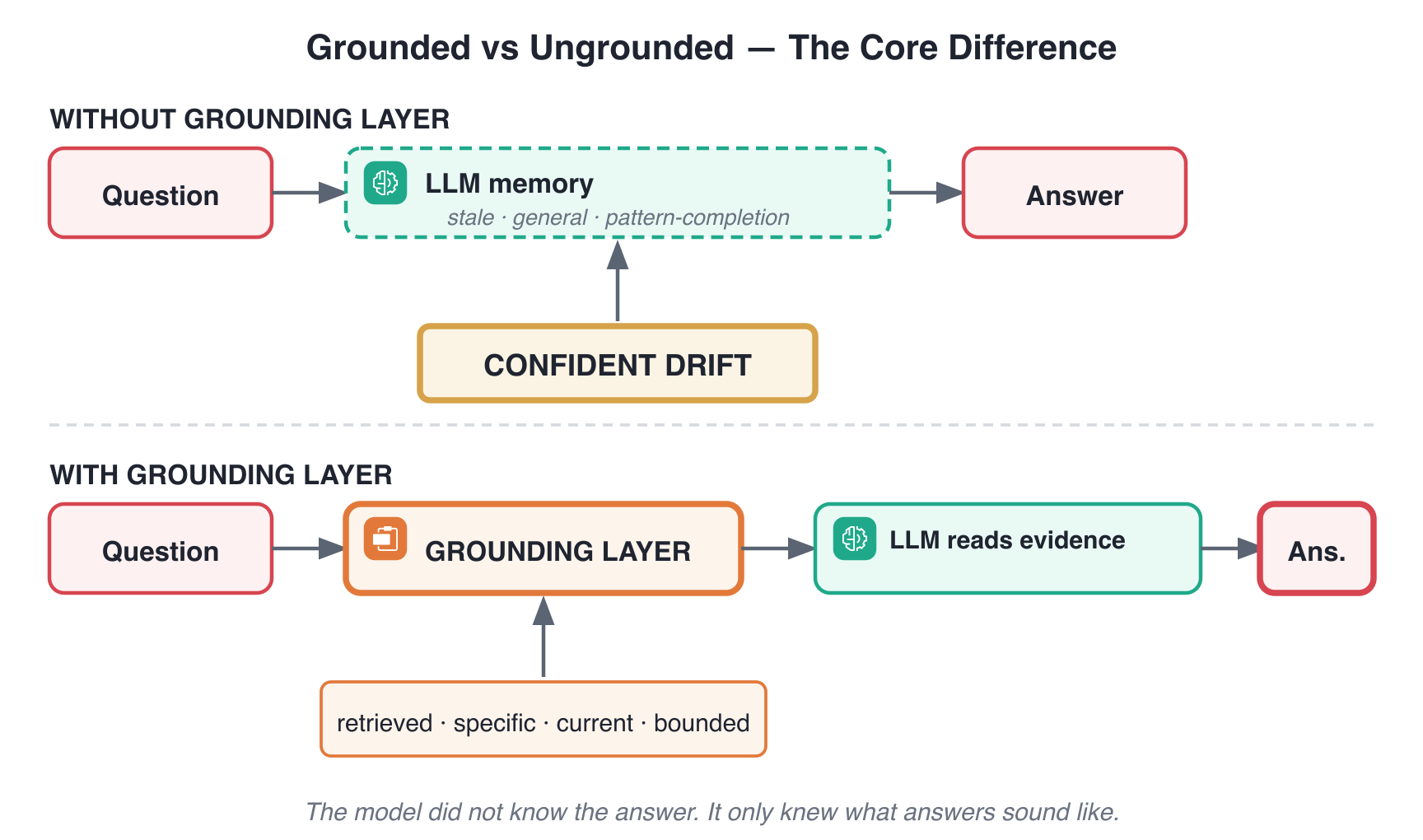
This failure has a name: Confident Drift. The model does not know it is wrong. It predicts what a correct answer would sound like — and every word arrives with total confidence. Your users believe it. You find out through support tickets, or you never find out at all.
No prompt fixes this. No temperature setting fixes this. The fix is architectural — and building that architecture correctly, measurably, from first principles, is what this series is about.
In Production
Watch the failure. Watch the fix.
Real queries. Real RAGAS scores. ShopBot — built across all 4 books.
✗Your chatbot answers confidently. You learn it was wrong from a support ticket three days later.
✗You try six different system prompts. The hallucinations move around but never stop.
✗You search for fixes and find 40 contradictory tutorials.
✗You don't know if your last change helped or hurt — there's no number to look at.
After
✓Every response comes from evidence the model actually retrieved and read — you can trace it.
✓When there is no evidence, the system says so. Users trust it more for saying no.
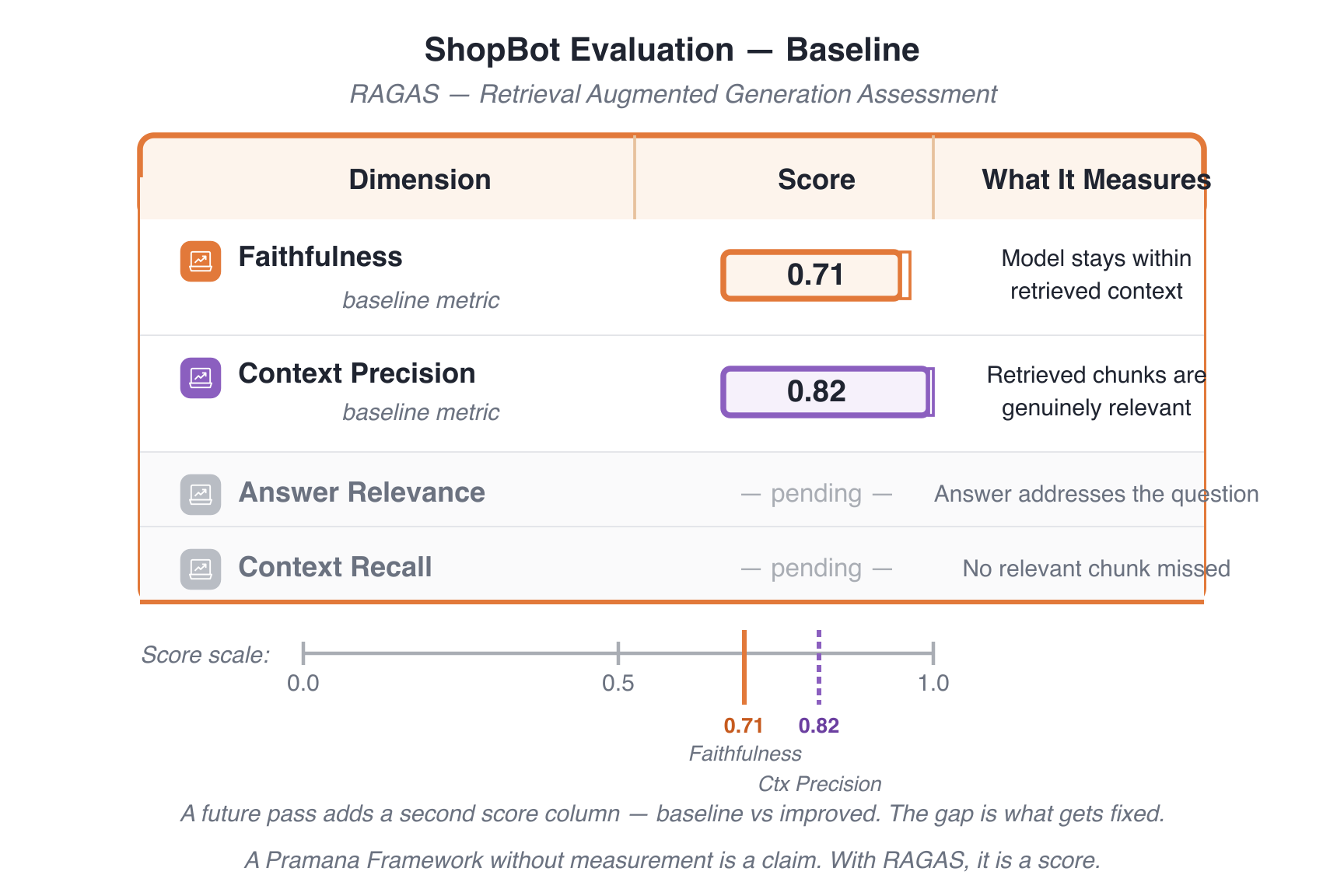
✓RAGAS gives you a real accuracy number. You watch it go up as the system improves.
✓You understand every design decision — not just the code that implements it.
The Pramana Framework
4+7
Books in Series
40+
Chapters Now
₹799
per year
“Pramana is a Sanskrit term meaning valid source of knowledge. That is what a RAG system is, when it is built correctly.”
— Zudyog
This is not a ChatGPT tutorial
A language model without retrieved evidence is not a knowledge source. It is a risk.
One project, the whole series
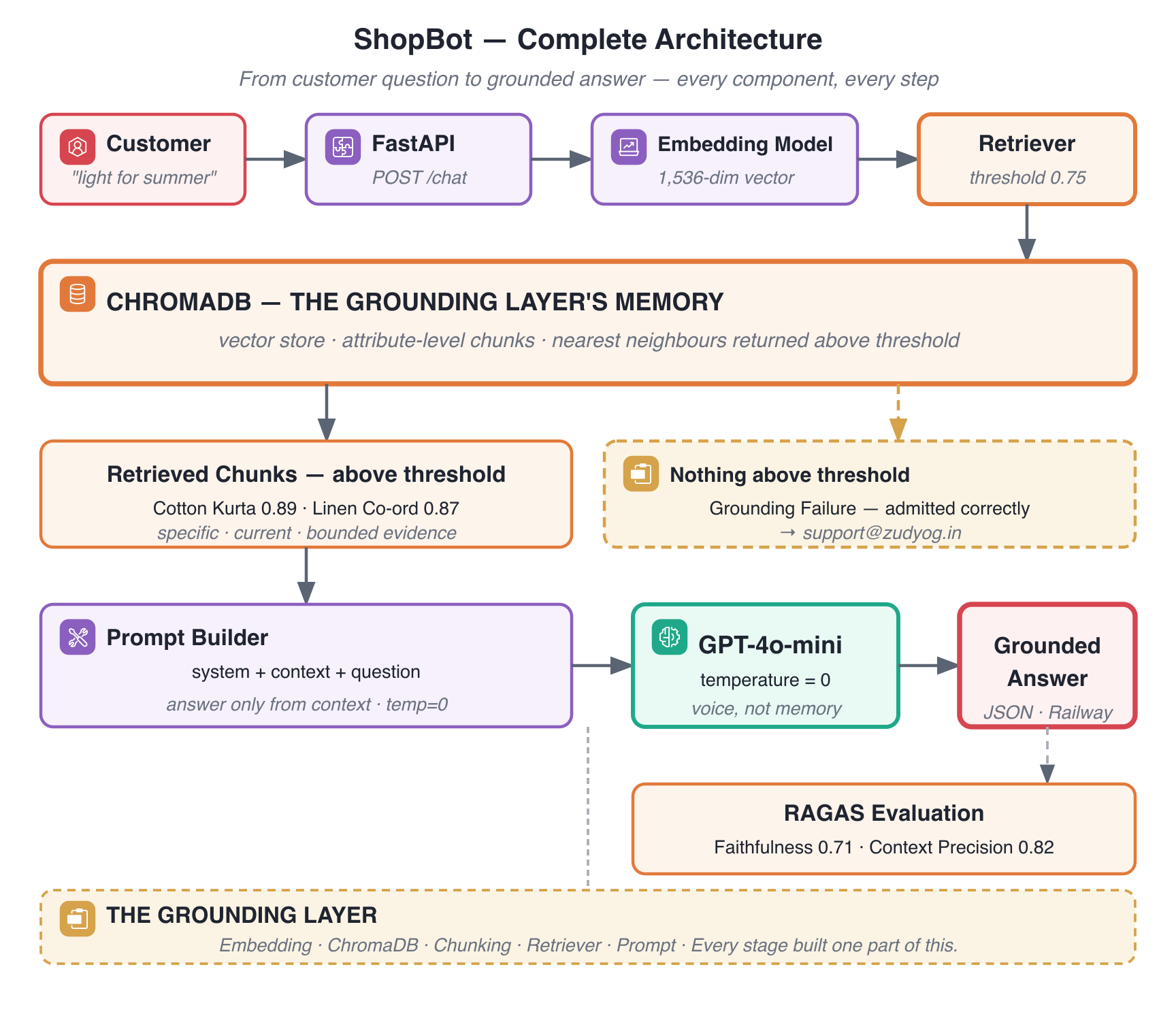
You build ShopBot — a real fashion e-commerce chatbot — across all four books. Shipped in Book 1. Upgraded in Books 2 and 3. Scaled to multi-tenant enterprise in Book 4. You never start from scratch. You always see why the last version wasn't good enough.
Every failure mode explained
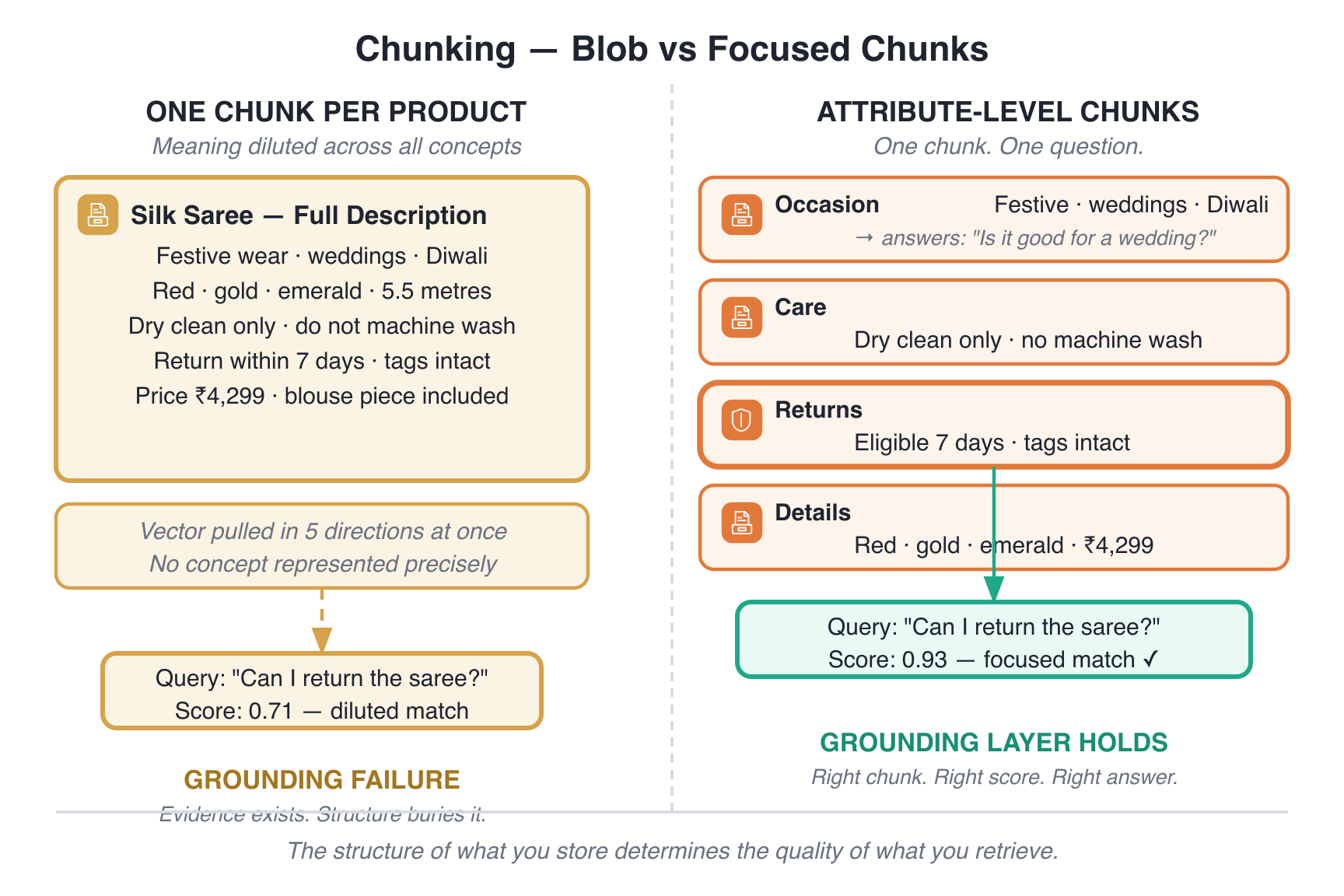
Confident Drift. The vocabulary gap. The 9% of queries no chain handles. Multi-tenant data leakage. Each chapter starts at the failure — the exact moment the system breaks — and builds the architectural fix. You will recognise every one of them.
Production-ready stack
Python · LangChain · ChromaDB · FastAPI · RAGAS · LangGraph · AWS Bedrock · Qdrant. Every chapter ends with a system you can deploy — not a notebook you close and forget. The tools are the ones your production environment actually uses.
“Don't just learn RAG. Think like the engineers who built it. Read the journey.”
The Complete Series
From first embeddings to enterprise deployment
4 core books available now · 7 companions releasing quarterly from Nov 2026
Every chapter you finish advances your journey. Every quiz you pass earns a badge grounded in what you actually built — not what you clicked through. The “Grounded Builder” badge means your system answers from evidence. That is a real thing to know about yourself.
Your Series Journey
1
Done
2
45%
3
—
4
—
+7
from Nov 2026
◈
Grounded Builder
Book 1 complete
⊕
Hybrid Thinker
Book 2 complete
○
Router Architect
Complete The Senior AI Engineer — Book 3
★
The Long Game
Complete all 4 core books
Readers
What developers say after reading
People who shipped AI apps, hit the same walls, and found the architectural fix here.
“I spent two weeks tweaking prompts before Book 1 told me I was fixing the wrong thing entirely.”
“Finished Book 1 on a Sunday. By Tuesday I had scrapped my old chatbot and started over the right way.”
“The first chapter is set at 11 PM with support tickets open. I stopped reading and checked if they'd hacked my laptop.”
“I've read a lot of AI books. This is the first one that made me feel stupid for what I'd built before — in the best possible way.”
“We had a production problem nobody on the team could explain. Book 4 gave it a name and a fix in the same week.”
Find Your Starting Point
Not sure where you stand?
5 questions about what you have built and what is breaking. Under 2 minutes. We tell you exactly which book to open first.
What is RAG, exactly?
Retrieval-Augmented Generation grounds a language model's answers in documents you control — not its training memory. Instead of the model hallucinating, it retrieves relevant passages and answers only from that evidence. Book 1 builds this system from scratch.
Why generic LLM guides fall short
Most tutorials show you how to call an API. They don't show you why your chatbot confidently answers questions with wrong information — or how to fix it at the architecture level. Confident Drift is a retrieval problem, not a prompt problem. That distinction is the entire first book.
One project, four progressions
You build ShopBot across all four books: dense retrieval in Book 1, hybrid BM25 + re-ranking in Book 2, adaptive LangGraph routing in Book 3, multi-tenant Bedrock deployment in Book 4. Each book ships a measurably better system.
Yes. All 10 chapters of Book 1 are always free — no account, no credit card, no trial period. Open the reader and start reading immediately.
Do I need to read all four books in order?
Book 1 is complete on its own — you finish with a working, tested RAG system. Each subsequent book upgrades the same ShopBot project, so they compound, but Book 1 stands alone.
What do I need to know before I start?
Python basics. Everything else — LangChain, ChromaDB, RAGAS, vector embeddings — is introduced and explained as you build. No prior AI or ML experience required.
What is the difference between core books and companion books?
The 4 core books build ShopBot progressively from a simple chatbot to a multi-tenant enterprise system. The 7 companion books go deep on specific topics — evaluation, agents, cloud deployment — and release quarterly from Nov 2026.
Start Today
You have been building on guesswork long enough.
Book 1 is 10 chapters of production RAG — from first embeddings to a tested, measurable system. Read it in an afternoon. Understand why your AI hallucinates and how to fix it architecturally, not with prompts.